https://www.theverge.com/2021/5/7/22425035/google-youtube-tv-roku-app-feud
An example of how Agile YouTube team is.
https://www.theverge.com/2021/5/7/22425035/google-youtube-tv-roku-app-feud
An example of how Agile YouTube team is.

Every single day since March we have been listening news on COVID-19. This pandemic that has spread all over the world is what in everyone’s mind even now, about 5-months later. Countries all across issued nation-wide state of emergency, many forces businesses to shut their offices for an uncertain period of time. Businesses are experiencing lost of businesses, revenues, and productivities from their workers. This is truly a crisis that threat the existence of the business itself. There is no option for businesses than to accept the COVID-19 situation and adapt to make it work in this new world if they want to survive.
Working for IT department of a large insurance company, I am fortunate to be exposed to various kind of technologies to enable remote working even before the COVID-19 situation. Virtual meetings and conference calls and VPN technologies are not something new to us. I am sure that the rest of the company is pretty familiar with these technologies as they are mostly standard issue. When the situation turned for the worse, my team in particular has been very prepared. We have done virtual stand-ups for at least a week even before the order to stay home was in place. Then the day came when employees are ordered to stay at home except for workers of critical functions that can only be done at the office.
I remember the rally after that. Volunteers from across IT was called under the banner of BCP, and enabling Remote Work. Unfortunately, I did not see first hand as a lot of these work are on infrastructure side. But I do get to experience the initial problems and rapid improvements, such as difficulties on connecting to VPNs and virtual conferences and slow connections. Nowadays, such issues are a thing of the past. Yes, I do experience slow downs or disconnection, but those are very rare.
Lately, there was a.. ‘survey’ that the company can do to gather ideas around how we can improve efficiency. Surprisingly, one of the most top rated idea is widening implementation of Remote Work policy. Somehow to people that voted on this idea, working remotely is actually more efficient for them. Isn’t this a sign of successful experimentation?
I can not say that this is true for the majority of population, that this is true for all kind of work, or that this is based on factual careful measurement, but that the perception is there was very interesting. What I believe is that there are people that experimented on various ways of Remote Working and find that it works for them better, and our team is one of the team that find it to be true.
The team that I am coaching currently is a small team. Composed of mostly engineers and analysts, with a strong business person as the product owner. However, the team has again and again impresses stakeholders and senior management on their deliveries.. all why doing their work remotely. And this is the truly where I witness how incredible human ability to adapt to changes to their environment, and improve and optimize the new norms.
Internally, we leveraged a lot of tools to help our work, integrated chat tools, video calls, screen sharing, file sharing and repository. Email is not our main way of communication anymore, instead it is mainly to interact to external group that require wide distribution or teams that prefer us to do that. We develop internal culture where we have virtual daily standups, open communications even over chat, we joke and complain in chat, we strive to find the most efficient way to communicate with other teams, even dragging them over group conversation or group calls immediately at times. We found new ways of working over remote, such as new tools to facilitate our retrospectives, or even making sure people can see meeting notes as it is being written in real-time to sync up people understanding on the spot.
But these improvements does not stop at the Teams level. I personally found how much time can be saved by just working from home most of the time. These are precious time that I can invest on my son, in particular. I am able to structure a schedule where I have the time to take care of my son day by day while staying productive. I got to work on his homework and education personally. I have more time to play with him as well. Thanks to that I am now closer to my son than ever.
These are also time that I can use to develop myself more. If previously I had to do midnight trainings, now I can find some time here or there to continue with my study, or spend the time to do my cycling hobbies for instance. How to make my time more efficient is probably been in my mind more times than ever.
Even though the title of this post is about remote work, what I wanted to share here is that we as person has a tremendous potential to adaption. Organizations are made of people and inherit the same ability. However, a lot of times we did not tap into this ability enough. Tough situations forces creates difficult situations for us to adapt, and in the process it is very possible that we may have discover something that is much better. Experimentation is also another way that we can use to tap into this potential (hopefully without making ourselves go into tough situations).
As an Agile Coach, I believe and does a lot of experimentation, in professional and in private life. Organizations, society, or what dubbed common sense sometimes forces us to a specific truth or way of thinking. I often get bothered with it. Not only because of the doubts, but as it somehow dismiss our ability to adapt. The only way to the truth is to challenge it. Of course, knowing which one to challenge and accept requires wisdom and is a different topic by itself.

This message from a software developer team member pops out in our group chat. I know that he is half-joking, teasing. I just smiled and let it pass. I know better than debating this on the public chat. However, I will admit that that comment gave me a feel of uneasiness, a little bit offended, maybe.
Japan government encourages kids to stay home and study due to the possible outbreak of corona-virus. Another software developer that is affected commented in the same forum on how it is amusing to see how the school is doing short teleconference every morning with the parents asking questions like: how was the homework yesterday, explaining the homework today, and if they need the teachers help. “It just like our daily stand-up even though they don’t know Scrum”, he commented.
When I thought about it, both these comments have the same underlying perception that drives it, the thinking that Scrum events or activities is only a kind of ceremony, custom, habits, signature of a Scrum team. It, unfortunately, undervalues the benefit of these events.
Magic is mostly illusion. I remember the stories back how someone will invent something that looks impossible and perform in front of nobles and kings. The realization that we couldn’t understand and reason on why something is happening gives the illusion of Magic. For people in the 10th century stories of people flying through the sky sounds like Magic. Yet when we uncover the science behind it, people can start to reason and understand. When the illusion is revealed, it is not Magic anymore.
Scrum is much in the same situation. People always hears and sees the success. They see the mechanics, and experience the culture and atmosphere. But rarely they understand why? The explanation and reasoning on the science behind it always feels lacking that it feels like Magic. How come just by doing a daily stand-up every morning, or doing sprint retrospective, it can produce such a productive and successful team? Surely this is a work of Magic or intervention from a higher being. (Spoiler: it is not)
As a reflection, it is my job as a scrum master job to educate the team on Scrum and Agile. Most of the time we teach the shape, construct, the behavior of Scrum leaving the science and reasoning behind it. Like teaching Kung-Fu or Karate, it is quick win to educate the team on the form, so they start experiencing the benefit. But stopping there is not enough. We need to educate them on the reasoning and understanding of Scrum and Agile. I like how the Shu-Ha-Ri describe this journey of a team (and ourselves). How, as a beginner, we should follow the form, break the form, and, as mastery comes in, forget the form.
I can’t avoid this to sound like a religion in the beginning. Teaching these concepts and science behind it can be very difficult and require people to change their mindset. And, changing people mindset can not be done in one night. However, I can treat these curious comments as opportunities :). Admittedly my team is still at a very beginner stage of the journey, and it will take more time to get them to a better shape as a team. My hope is that sometime in the near future we will be ready to understand the science behind Scrum and Agile.

Recently, I was shared this church bulletin from a friend. There is a story in the bulletin where a 67-years old grandpa describes his journey and achievement on completing a 42-kilometers marathon after five years of trying. He described the journey on how he was able to this feat, and this interests me.
His story starts at the birth of his grandson. They named the boy after a mountain name. And that is his initial motivation comes from. It was never something like running or completing a marathon, he dreams that someday he will be able to climb that mountain that his grandson is named after together with the boy. He knows at that moment he lacks the strength to climb a mountain, and so he sets himself of starting to do exercises. He started by doing a series of walks around the area where he lives, following a method that is called walking interval training. The idea is to alternate 3-minutes of normal walking and 3-minutes of fast-walking. After almost a year of training, his legs finally gained the strength to do some simple hiking.
Nevertheless, he didn’t stop there. He continue to challenge himself doing interval training over longer and longer distances. Around this time, he was introduced to a more advance of interval training where it replaced fast-walking with 3-minutes jogging. It was though at first, but his training continue build strength and stamina. And, after a while he started running 2-km continuously, and keep on extending the distances.
Now, after completing the marathon, he looked back and feels very proud of being able to complete this feat. I am sure that he is more confident than ever to realize his dream of climbing that mountain with his grandson.
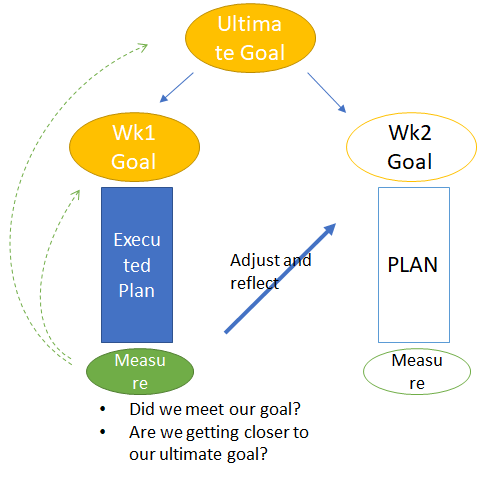
Whenever, I hear a story like this, it always amazed me how people get motivated and keep on challenging to improve themselves and meet their goals. The goal for this grandpa is very clear, he wants to climb the mountain that his grandson is named after together. Guided by this ultimate goal, he sets a goal to strengthen his legs by starting the interval training. He completed a milestone when he hiked the first time. But, he didn’t stop there. He knows that is not enough to reach his ultimate goal. He continued his training, and setting even a higher goal of being able to run non-stop for a number of kilometers. Then, he completed another major milestone, which is completing the 42-kilometers Marathon run.
Setting goals that are clear and tangible are very important to keep us always motivated. Completing a goal and milestones gives us a sense of satisfaction that is rewarding. Even though our ultimate goal maybe far stretch and difficult, we knows that each goals and milestones we completed brings us one step closer achieving the ultimate goal.
Scrum and Agile Product Development brings back empiricism and borrows a lot from this idea. The way we position ourselves toward the grander Goals and Vision guiding our immediate goals. How we keep challenge ourselves sprint-after-sprint to be better and improve ourselves. This is how the team grows, and how the product grows. Having your team or your company looking at the same ultimate goal, pushing yourself toward the next goals and milestones, celebrate and learn on past achievements. Good luck!

Note: This is a story and recollection of one of my past experiences. While it is based on my true experience it may contain some fictions at places.
Around mid-December, I was invited to a briefing meeting one day on a new project that I have been hearing for a while. As a person who has been in the company for a while, and ran large transformation project in the past, I know the drill and what to expect. As I expected, it was the usual high-level explanation and sharing of a new project that they are going to run, and as I expected as well, our team who is currently responsible for a related product is asked to take part in this new initiative.
Our team is the first team to pilot and successfully operate under Agile banner inside our multi-national organization here in Japan. Recently, we have been asked to take over stewardship of a product that was produced and expanded in previous projects. Looking at the rough track record of the development in the past, the stakeholders for this product are critical on introducing changes to the current product. When they heard that our team works on Scrum/Agile than the typical Waterfall approach they are used to, they are even more concerned. And this is what the meeting is about. At the end of the meeting, I received a laundry list of typical questions such as: ‘what is sprint planning? who should attend? who will write the user story? who should come to the sprint review? …’
This is not the first time I was asked these kind of questions. Answering these questions need a holistic view of how Scrum is and it will require a Scrum introduction/crash-course at a different time. Only this time, I wanted to try something different.
Scrum is logical. Not a lot of people realize that. Many thinks of it as a recipe, a procedure, a method, to be followed, just like Waterfall method. Scrum is also simple. Once you get into the basic ideas it is easy to understand the necessities that the framework addressed. It’s like learning how to ride a bicycle. Once it all clicked, you will never forget! The problem is how to get to this level understanding. In my experience the best way to learn is ‘Active Learning’. And that is exactly how I wanted to address these questions.
The new years went by quietly. As usual, people started slowly after the new years, which is a blessing. I was able to spend some time to explore various ways of the approach for this session. I wanted it to be around something that is close to people experiences, so that they can easily engage in discussions, and but sufficiently representative of Scrum framework, as not to lose the main ideas behind it. And, I found an idea.
“You may all come here and expect me to introduce and rehearse about the Scrum Framework with all the loop charts and diagrams …”, I said opening the discussion meeting that I titled ‘Scrum Introduction’. “Well, rather than getting you bored with what I believe you already seen many-many times, I wanted to do something different.. I want to do a little of role-playing. So, please follow along.”
“You are 6-months to your wedding that you meticulously prepared. You had the venue booked, the catering prepared, the proceedings thought of, the invitations sent out, and you have chosen the most beautiful wedding gown you ever laid your eyes on. Just one problem, it is a little tight around the waist (uh.. oh). So wanting to be sure you looked absolutely best at the day, you set this goal in mind: ‘I will lose 5kg of weight for the wedding.'” I paused, to let the idea of losing weight take a good foothold in their mind. “Now, please tell me, what will you do?” This was the premise of our discussion. I drew a large circle and wrote: ‘-5kg in 6m’ at the center.
“I will stop eating rice!”, one of the lady commented immediately grinning toward me. I know she was half-serious on the comment, but as a person who been working among the Japanese society getting the first response is usually is the most difficult. I know I will be forever grateful to her for taking this first step. “Very good!”, I wrote that point on the whiteboard. ‘So, I will now not eat rice again.. ever..’, I said half-joking and smiling. “I’m going to die.. “, another person commented. Everyone laughed.
“Well, we have 6-months, so if we lose 1-kg every month.. “, said a lady from strategy / planning function. I can see where she comes from, and it sounds very logical breakdown of goals. “Excellent! Now we have a target for every month. ‘Drop 1-kg every month'”. I noted that on the whiteboard as well. “So, what should I do if after 1-month I didn’t drop 1-kg?”, a probing question on options. “Add sport!”, a gentleman who has been sitting quietly suddenly gave an idea. “What a wonderful suggestion!”, I jotted down the idea.
“I also suggest, that you start measuring how much your weight currently is”, he quickly added. “Very important indeed!”, I added that.
“How about doing a reporting meetup with your friends every week?”, a suggestion from another lady. I am always amazed how Japanese people sometimes have this nifty methods of getting people in their group motivated. And yes, this is one of the common thing they have. I added that to the list
“So, lets see.. If I extended this idea of breaking down the Goal to weeks, I can say that I want to aim of losing 250g every week”, I extended the big-circle goal to create a tree of months and weeks. In each week I wrote ‘-250g’. “I want to focus on the first week. Lets say that we are going to start this from the following Monday, and the method is the ‘not eating rice’ method you suggested, how is my week would look like? Remember, we have the reporting meetup on Sunday!”

I drew a table of with days of the week in the column, and ‘breakfast, lunch, dinner’ as the rows. So, the group decided that we should avoid rice and be a ‘goat’ eating salads for dinner. Breakfast and Lunch can be standard, but maybe less rice a couple of days in the week. The last day should be the ‘reward’ day. So, Yakiniku-lunch is in order. We should also weight ourselves in the morning everyday, and keep record of what we ate and our weight for the day.

“Now lets, fast forward a week after. You have executed your week plan, you stick to the plan, eat less rice, and you have a record of what you ate and weight everyday. Now, it is time for the super important ‘reporting meetup’ where you are telling your diet story to your friends and the result. Imagine if you’re telling them a success story of how you shaved off 250g in one-week! What would be their reaction? I am sure that they will be praising and be happy for you. What should you do for the following week? Do the same.. right?”. Some people nodded their heads. I know I rushed and could have engage them in the discussion, but I’m a bit pressed on time, so I wanted to get them into the important question. “but.., as what typically happens, what if we didn’t meet our goal? I am sure our friends will start giving us suggestions. What would that suggestions will be?”
“Skip breakfast!”, someone shouted. “Very stoic”, I smiled and wrote it on the whiteboard.
“Now we should do some sport?”, the same gentleman suggested. “I cycle almost everyday myself”, I nodded in approval.
“.. So now, we can modify the plan to incorporate Sport and eating ‘less’ breakfast. I crossed breakfast on some days, and added some markers indicating sport day to the table.
It is time for me to try to link this back to how Scrum works. “Our team works pretty much the same way as this”. I avoided the word Scrum and instead use ‘our team’ as not to let them lose focus. “We work with a series of goals that if achieved brings us closer to the ultimate goal. Which in this diet story is to lose 5-kg in 6-months.”
“So now we know that a Goal need to be descriptive, and a way to measure if we achieved that goal or not. In the first week, our goal is to lose 250-grams, and the way to measure it is to weight ourselves. We then plan our week to achieve that goal. This is our week diet plan, where we plan what we eat everyday, and weight ourselves every morning. At the end of the week, we will measure where we are at and based on that feedback we will change the plan and the goal for the following week. Maybe we will set for a more stricter goal of losing 300-grams of weight.”
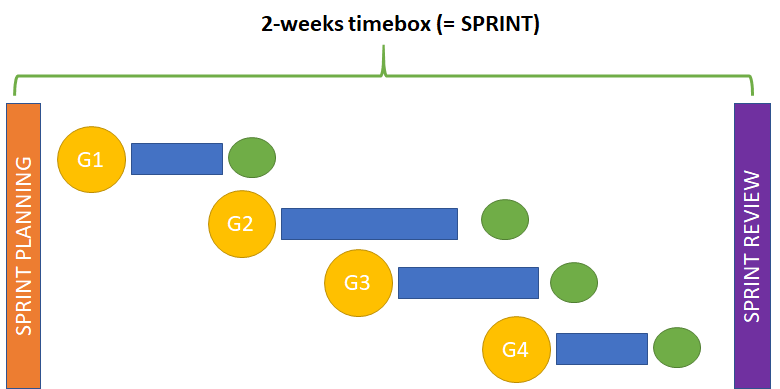
“Let me give you a bit of explanation of some of the mechanic in Scrum to give you a bit of construct before we continue. A sprint is a timebox. Our team use a 2-weeks timebox as a default. Inside this time-box we are chasing a number of Goals. Each goals has a plan and a way to measure the completion of a goal. At the start of the Sprint we have a Sprint Planning, and at the end of the Sprint there is a Sprint Review.”
“So, based on your understanding now, what is a User Story and Acceptance Criteria?”
“Goal and how you measure?..”
“Excellent! To me a User Story is a goal that is written from User perspective, and the AC is how we measure if we met the goal or not”
“Now, what do you think is a Sprint Planning?”
“It’s a planning session.”.
“Correct. But what do you plan for?”
“Plan for the goal?”
“Excellent! Which goal? All the goals?”
…
“Aha! Now if its our own diet plan, the answer is easy as they goal is pretty easy and we can decide by ourselves. Not so quite for product development. If we are drawn to projects, the time is usually fixed, deliver x by y. But, products are not that simple. Bring in profit/revenue is the usual ultimate goal. This is complex and have so many factors involved such as timing, effort, cost, market conditions, customer voices, organization readiness, politics, etc. The person that have the visibility of all these factors and willing to fight and bring the most value to the customer of the product should be the one who decides and prioritizes the goals. We call this person as the Product Owner. It is a very difficult and demanding role as he is owning the product, and his success and failure depends (ideally) solely on the performance of the product.”
“So, now we understand that, what is the input to Sprint Planning?”
“.. Goals..?”
“Exactly! The prioritized list of goals is what we call the Product Backlog. The team will start discussing the goal and plan for the goal from the prioritized items. Does that makes sense?”. Everyone nodded.
“So, what is the output of the Sprint Planning?”
“Goals and plans?”, I nodded. “Very good. Please understand the implication of this very closely. If the Sprint Planning did not result on a plan, what will happen?..”, I paused waiting for an answer. However, everyone is anxious, looking at me to give them the answer. I continued l, “.. nothing move. The team will not be able to do anything for the sprint. That is the ultimate failure of a Sprint Planning.”
“So, the prioritization does not happen in Sprint Planning? Is it pre-prioritized?”, a question pops-out from the crowd.
“Good question. Yes, the input of Sprint Planning is a ‘prioritized backlog’. This should happen before the Sprint Planning happen. And, to further explain.. and avoid what misunderstanding, the prioritization can change at any time at the discretion of Product Owner. Remember that feedback can change the plan and goal? PO get feed backs all the time.”
“Shouldn’t the team give feed backs to PO as well?”
“Yes, of course! They are very critical feed backs especially on size and effort of a goal. However, the development team is usually very focus and busy with their work. We don’t want them to switch context at any time. So, we usually created a slot where the whole Scrum Team will gather and discuss on several product backlog and get feed backs. This is called the Backlog Grooming session”
“Now to get back to our Sprint Planning discussion, who do you think should attend the Sprint Planning?”
“The Scrum Team?”
“Of course, they are the one who creates the plan. But, who else should come?”
“Analysts.. ?”
“.. Project Managers? Architects?.. Everyone?”, I smiled. “Remember Sprint Planning is very important, and the Scrum Team must produce a reasonable plan. So the most generic answer I will say is ‘everyone that can contribute on creating the plan for the sprint’ should be invited. But that can mean the whole universe, right?”, I laughed.
“In execution, there are a lot of hints on who should be invited and it may differ for each Sprint Planning session. You will notice that some people that have strong domain knowledge that often contributes are usually get called on the meeting. When we expect to do large system designs or architectural changes, maybe people from architecture will get called. So, thematic changes are hints on who should we invite. Another hint also comes from the team themselves, maybe comments they made in the Backlog Grooming session. “
“Capturing all of this, preparing for the Sprint Planning is one of the work that a Scrum Master and Product Owner is working. Most often, the analysts in the Scrum Team helps us to prepare the materials and investigation for then upcoming sprint. This often ensure that we have enough knowledge in the team for them to make reasonable feasible plan in the Planning meeting.”
“Now, if we have a number of goals, and completed the first one in the 4th day. Where does the measure should take place? At the end of the Sprint, more than a week after?”
People shakes their head
“That’s right. Ideally we want to measure it immediately! If something is not correct, we want to fix it quickly as well, so we can be 100% focus on the next goal. The team can try verifying it themselves, but wouldn’t it be best if the people that uses it or knows how it should be, verifies it? In the same sense, it will be great if we can get answers on questions when we are developing things so we can change our plan quickly. And this is exactly what we are asking from people outside of the team. We want you as the business users, to help us clarify and verify quickly as soon as possible.”
“So, what is Sprint Review then? A lot of people thinks it is a review of the product where we verify each acceptance criteria or test cases one by one.”
“That is incorrect. It is far too late to give feedback on the details of the product every to weeks. Further, it is impossible to fit this in an hour or two meetings. I can sum the purpose of Sprint Review to three main activities: Update on the Status to our stakeholders, Update them on our current direction and plan, and get their Feedback on the direction. The focus is Stakeholders. This is a very special and important event for Product Owners to promote and ‘sell’ the product to them. I always tell people to imagine how every year Apple hold this product conferences, and how Steve Jobs present the product on stage.”
“We gave a demo to the stakeholders to give them an image on the state of the product. You maybe surprised on some of the feed backs they gave us. While you maybe in the adrenaline rush of developing and pushing more Features to the product, a stakeholder may say maybe we need to stop on adding more features as it blurs the purpose of the product. Some may sees that we have so many valuable features that we should focus on pushing the current features immediately to Production as this is what exactly what the market wants. And, some may have concerns on information protection and securities, and suggest as to work on those. These are very valuable feed backs to Product Owner and the Team. They will evolve the Product Backlog based on these feed backs as well. The second benefit is that it provides Transparency. When the resulting product is presented in front of everyone, there is no place to hide anything under paper and reports. What you see is what you get.”
“Now, I want you to turn your attention on the ‘Sprint’, the time-box. Why do you think we have a time-box? What is the benefit?”
“.. so we can check?”
“Good try! But probably not quite. Just like you are doing day to day work maybe in operations, and maybe in your life. We like things to be stable, repeating, expected, a routine. Maybe you have your routine of taking out the garbage. Or in our example, we have a routine of measuring our weight every morning.”, I explained. “The good thing of a routine is that we can predict what should happen at what time. This means, we can plan. We know that the Sprint is always two-weeks and the first day in the morning is our Sprint Planning. The team knows they need to clear that time slot for the meeting. The team also has a daily stand-up routine at 10am. So they plan and make sure they will get into the office by 10am. So, routine.. predictable.. able to plan, first benefit.”
“The second benefit, it helps limit the size of goal and planning. Remember the 6-months 5-kg weight loss program? Think about how difficult it is for us to meticulously plan our lunch everyday for the next six months. We all are well aware how diet plan changes every week, right?”, able to relate, everyone laughed. “It ensures that a goal must be achievable in one sprint. PO and the team will be collaborating to break down goals to break down big goals to smaller ones.”
“Third benefit, as the cadence is regular, the productivity of the team should pretty much stable for every sprint. This helps the team to reflect on how they can improve and be more productive sprint after sprint. In act, this is so important hat we have specific event to do this, Sprint Retrospective. The regular cadence and productivity also helps PO for forecasting which in the end gives more transparency to the stakeholders”
“So now, we have come full circle. Were you able to grasp behind the idea, and do you have questions around all of these?”
“If there is any requirement changes, do we need to create a ‘Change Request’?”, a business member asked.
“Ideally, no. Due to the nature of our iterative approaches, you always have the opportunity to change things in the next iteration. However, the priority of this change will depends on PO determination, and that may mean that some lower priority items not get delivered at a certain time. Speaking of which, you touch a very good point. Especially when integrating with a traditional project where delivery at specific time is required, there is a need to understand what is being delivered and when. We used a forecast in the past to do this, and certainly such a report can be useful in Sprint Review as well. “
“Should we attend the Daily Stand-up?”, ask another business member.
“Depends on where you are. If you are part of the team that is executing the plan personally toward the goal then Yes! This is a team collaboration effort. You need to communicate and sync with your team mates if your plan is still valid, and if you need help or not. If you’re not executing personally, then maybe you don’t need to. No one is stopping you to observe though. For example, the PO frequently observes our daily stand-ups but very rarely participate in our discussion. He does give us input if required.”
And that is pretty much the end of our discussion, and about time we end this discussion “So, I hope this all makes sense to you and answers most, if not all, your questions. If you have more questions, please email me and I’d reply or maybe setup another session.” I can see everyone have a good look and understanding on this. “.. and if you need pointers on these Scrum stuffs, just remember and think of our ‘diet plan’. I am sure that will help you a lot. Thank you.”

Dear Friends,
This is my first time blogging and this is my first post. I have been thinking for a while of doing my own blog but for one reason or the other I haven’t been able to execute on the idea. Well it’s 2020! And you know rather than just keeping the idea as just that.. an idea, wouldn’t it be better if I just take the leap and see how far this goes.
People that knows me professionally, knows that I am a work as an Agile Coach and Scrum Master, a field and job that I am very passionate about. However, people that knows professionally and personally, undoubtedly notice that I am an avid cyclist. This is a hobby that I started about three years ago, and went very serious for the last year and a half. What people doesn’t know is that I draw a lot of experiences, insights, and inspirations on Agile from the Cycling world. And that is the reason for the title of this blog: ‘Agile & Cycling’ (I should probably think of a cooler name than that 😁).
I intend to share my ideas and thoughts both on Agile and Cycling here. My hope this will be inspirational and useful for people that reading my blog. I am sure this will be an awesome learning adventure for me.
Sincerely,
Andrew Murniadi

 Agile & Cycling